The Colony That Cannot Come Home
The Greeks sent cities out with fire from the mother hearth. Mars is the first settlement that cannot keep the flame, and the new world will edit its settlers whether they consent or not.
The living ember
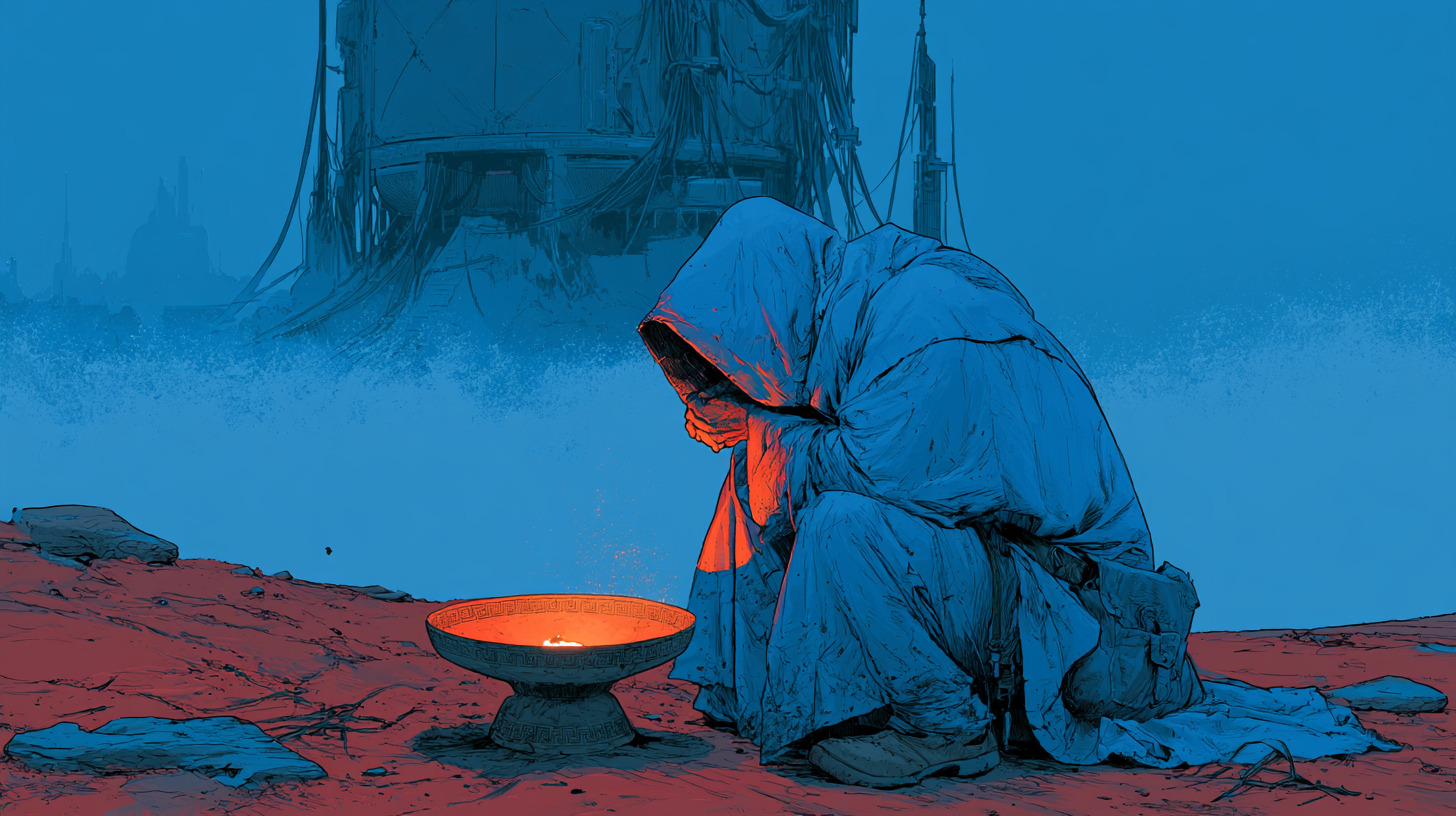
When the Greeks sent a city out from a city, they carried fire.
Not a torch for warmth. A living ember from the sacred hearth of the mother-city, the common flame that never went out, carried across the sea to light the new hearth so the two burned from one source. The settlement was called an apoikia, a home away from home, not a colony in the sense we have soured the word into. It made its own laws, answered to no governor across the water. But it kept the fire. The fire was the thread. Massalia burning from the flame of Phocaea, Syracuse from Corinth, Cyrene sent out from the island of Thera when drought starved the mother-island and the god at Delphi pointed at Africa. They left, governed themselves, and were still kin: one fire at both ends of the sea. That was the genius of it. You could leave home completely and still belong to it.
You could leave home completely and still belong to it.
Shouting across the canyon
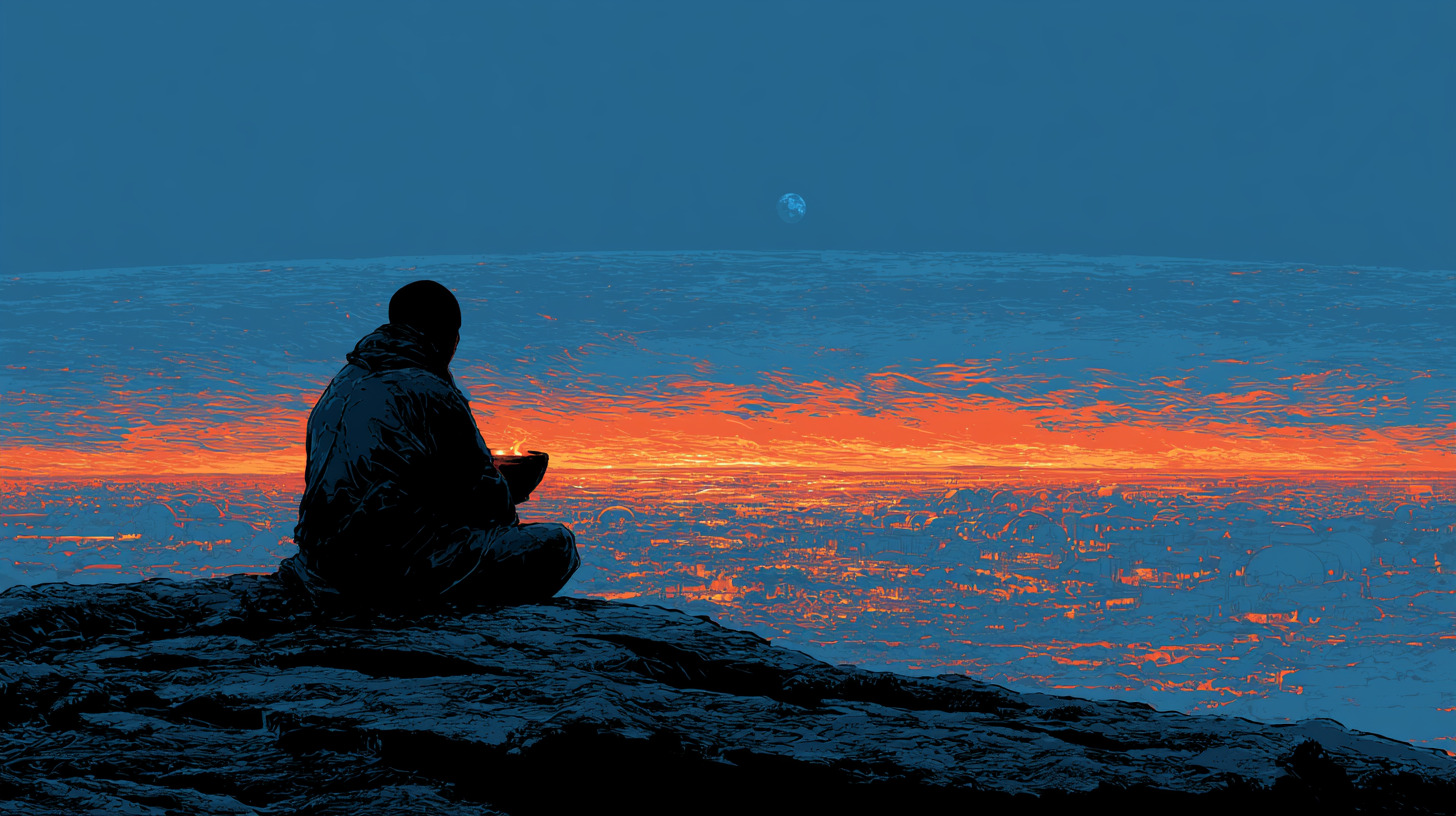
Mars is the first apoikia in human history that cannot keep the fire.
Not because we lack the wick. Because the distance is a different kind of distance. The sea between Phocaea and Massalia could be crossed in weeks, and crossed back. Mars is months away, behind a lag of light: you speak to it by shouting across a canyon and waiting for the echo. A thing you can only speak to on a twenty-minute delay is already drifting out of the conversation. The thread that kept the apoikia kin was the fire passing back and forth. Across that distance it cannot be kept alight from home. The child that leaves this home cannot come back, and cannot stay the same.
Every tine at once
And it cannot go as it is: the part that gathers the whole chapter into one place.
An unmodified human body is not built for that world. I say this at the honest altitude: strong expectation, not settled fact; the science is real, the conclusions still argument. Mars has no air you can breathe, an atmosphere almost entirely carbon dioxide. It has a third of this gravity, and nobody knows what a body grown from conception in a third of a gravity becomes: bone, heart, spine, across a childhood, then across generations. It has radiation that Earth's thick air and magnetic field spare us and that thin world does not. To live there is not a matter of a good coat. To live there is to change the body to fit the world (the augmentation of essays four and five), and to have children further changed, by design or by the slow pressure of a different world on a heritable line, the germline drift of the gravest essay in this book. And to survive there at all is to bring the machines of the last essay along. Mars is not a new tine of the fork. It is the arena where every earlier tine runs at once, with no Earth near enough to referee.
The ark has a list
I have to be honest about the timelines, because the men who sell this sell it as the day after tomorrow, and it is not. The most ambitious private program has quietly slid its Mars horizon into the 2030s and turned back toward the Moon. A national program plans to bring a handful of Martian soil home around the start of the next decade. Real, moving, and nothing like the founding fleets of the sales pitch. What is true is the direction, not the date. And the direction has no referee, because several nations and a few enormous fortunes are all reaching at once, and no world body decides who goes.
Which is the justice question this chapter will not let me skip. The story these programs tell is the backup of humanity, the lifeboat, the ark. But an ark has a list, and someone writes it. Backup of humanity quietly means backup of a chosen sliver, decided by who can pay the passage and whose flag flies on the hull, while the rest stay on the world damaged enough to make the ark sound reasonable in the first place. Whose humanity gets saved is the whole of the question, and it is being answered right now: by default, by price, by nobody who was elected to answer it.
Here is the old hope I carry, and its turn. I have always loved the idea that the Earth is a single living thing: we less its masters than its cells, ants laying down the nervous system of a planet slowly waking up. In that story the planet reaches adolescence, sends out its first voice, that first broadcast that ever left the atmosphere, and begins, like any adolescent, to seek its other half, a partner similar enough and strange enough to answer. I believed that. In a way I still do. But the apoikia teaches the cruelty folded inside it. We reach out to find the other, the kin across the dark that will reflect us back. And what we are actually building, when we send a branch of ourselves to a world that will re-carve it in body and sky and time until it can no longer speak to us without delay, is not a meeting with the other. It is the manufacture of the other out of our own children. Gaia's child does not find a stranger to love in the cosmos. Gaia's child goes out and becomes the stranger.
Gaia's child does not find a stranger to love in the cosmos. Gaia's child goes out and becomes the stranger.
Send only the pattern
So the apoikia that cannot keep the fire is not a story of failure. It is success so complete it stops being reunion. The settlement thrives, and in thriving grows so far past the home that made it that it becomes another kind of being, under another sun, on a delay from which no answer comes back in time to matter.
And if the body cannot cross these distances and stay ours, the next thought has been waiting since the first essay. Stop sending the body. Send only the pattern. Leave the flesh behind entirely, and find out, on the far side, whether anyone actually arrived.